Home › Sitework and Structural Concrete
Superior Concrete San Jose performs sitework and structural concrete in San Jose, TX for commercial and industrial projects. We build retaining walls, equipment pads, piers, pedestals, and other structural elements in coordination with your design team and schedule.
Superior Concrete San Jose provides professional structural concrete throughout San Jose, TX, Texas and the surrounding area. Our licensed, insured crew delivers safe, clean, on-time work with a free estimate before anything begins. Call (956) 857-9315 or request your free quote.
Sitework and structural concrete for San Jose properties
Sitework and structural concrete are the parts of a project that actually carry the load and keep water and movement under control. At Superior Concrete San Jose, we focus on getting this phase right for local homes, shops, and light industrial buildings in and around San Jose, TX.
Most of the projects we handle are on clay-heavy soils with some rock, which is typical in this part of Texas. That affects how deep we dig, how we compact the subgrade, and how we design the reinforcing steel. A small mistake in this early work can lead to cracked slabs, doors sticking, and ponding water around your foundation. Our crews are trained to look at drainage patterns, surrounding grades, and existing structures before any concrete truck is ordered.
We handle everything from new house slabs and shop floors to thickened-edge foundations, grade beams, structural footings, and machine pads. We also tie this work into flatwork like driveways, approach aprons, and sidewalks so you do not end up with mismatched elevations or joints that collect water. Our goal is a structure that holds up to Central Texas soil movement, heat, and heavy use for many years.
How we approach sitework on San Jose, TX projects
Sitework is the groundwork that makes structural concrete last. For properties in San Jose, it usually starts with clearing brush, old slabs, fence remnants, and topsoil. We then strip soft material down to firm native soil or a stable fill layer. If we hit pockets of soft clay or organic material, we over-excavate and replace those areas with compacted select fill.
Subgrade prep is where many cheaper bids cut corners. We shape the area to the design elevation, then moisture condition and compact in thin lifts using plate tampers or rollers, depending on access. We routinely use density testing on larger projects so the builder or owner has proof that compaction was done correctly. Proper compaction is what prevents slab settlement and cracking in the first few years.
Drainage around San Jose properties is another big part of sitework. We check how stormwater runs across your lot and adjust grades to direct water away from the building. In low-lying areas we may recommend French drains, swales, or extra gravel around the perimeter. If you are tying into existing driveways or county ditches, we take those elevations before we start. This avoids surprises like a new slab sitting too high to drain or too low so it floods in a thunderstorm.
Utility coordination comes next. We locate or expose existing water, sewer, and electrical lines so we do not damage them. For new builds we set sleeves and conduits where the plumber and electrician need them so you are not cutting through brand-new concrete to run a line. Only after the sitework is right do we start setting forms for the structural concrete.
What structural concrete actually involves
Structural concrete is everything that carries real loads. That includes foundations, beams, columns, and structural slabs that support walls, roofs, machinery, or vehicles. In San Jose, TX most residential jobs involve post-tension or conventional rebar slabs, thickened edges, and grade beams. Light commercial and farm or ranch projects often include thicker sections, heavier reinforcing, and deeper footings for metal buildings or equipment.
Our process starts with your engineered plans if you have them. If you do not, Superior Concrete San Jose can work with a local structural engineer familiar with South Texas soils. The engineer determines slab thickness, beam depth, bar size and spacing, and concrete strength. Typical mixes in this area range from 3000 to 4000 psi, but we adjust based on use. For example, a shop where heavy trucks will turn may get a higher strength mix with fiber reinforcement.
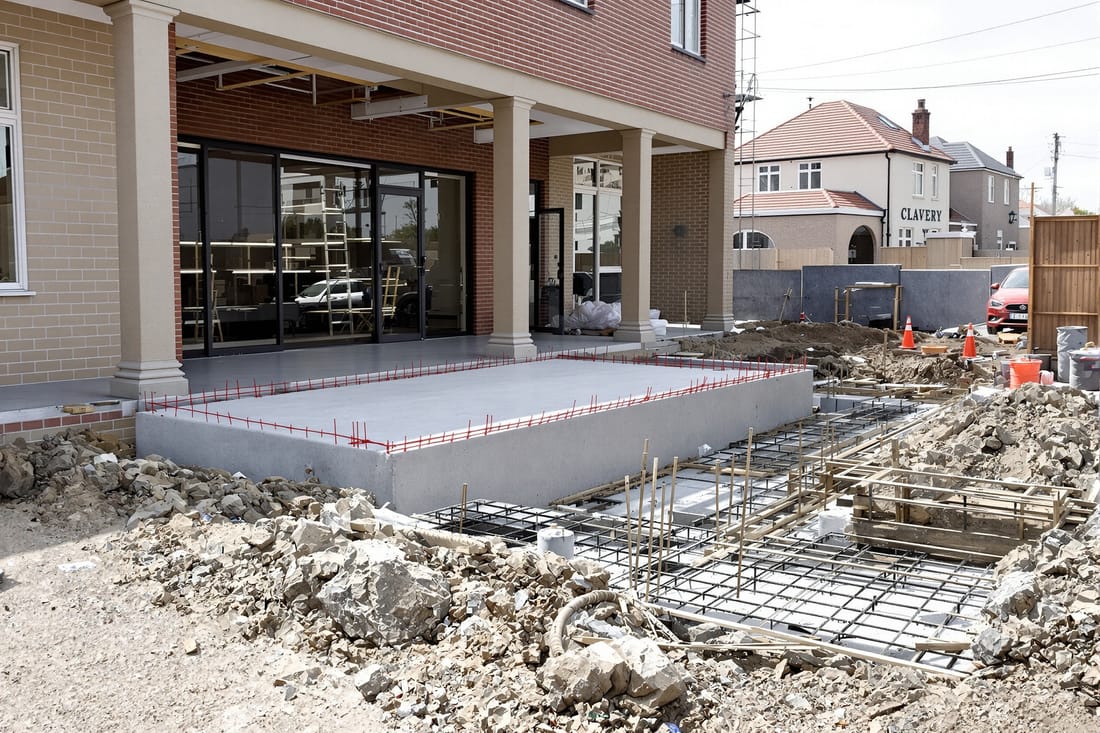
We set forms to the design elevations, then place vapor barrier and base material where required, usually compacted gravel or select fill. Reinforcing steel is then installed per the drawings, with proper cover from the soil and chairs to keep it at the right height. On post-tension jobs we install cables in a pattern that matches the engineer’s layout and have them inspected before the pour.
Concrete placement is carefully planned around weather and site access. We schedule trucks so there is continuous placement and no cold joints where they are not allowed. Our crews use vibrators around rebar and in beams to remove voids, then screed, bull float, and trowel the surface depending on the specified finish. On structural work we pay close attention to curing, using water curing, curing compound, or coverings so the slab does not dry out too fast in the Texas sun. For post-tension slabs, cables are stressed after the concrete has reached the specified strength, which we verify by time and, on critical work, by test breaks.
Costs, options, and common problems we solve
The cost of sitework and structural concrete in San Jose, TX is driven by several specific factors: soil conditions, slab thickness, type and amount of reinforcing, access for equipment, and how much grading or haul off is needed. A slab on a flat, open lot with firm soil is always cheaper than one on a tight site that needs tree removal, deep fill, or retaining.
Material choices also affect pricing. Higher strength mixes, fiber reinforcement, thicker edge beams, and deeper grade beams cost more up front but save money when the structure is supporting heavy walls, mezzanines, or machinery. We walk customers through what is truly needed for their use so you are not paying for overbuilt features that add no value or underbuilt work that will fail early.
Common problems we see on local projects include poor drainage that leads to water standing against foundations, rebar placed directly on the ground so it ends up at the bottom of the slab, and slabs poured over soft fill that later settles. We address these by reshaping grades, adding drains where necessary, raising reinforcement on chairs and checking spacing before the pour, and compacting or replacing weak areas.
For additions to older homes and shops, tying new structural concrete into existing work is also critical. We often drill and epoxy dowels into existing slabs or beams so the new concrete does not move independently and create trip joints or cracks at the connection. Where the old structure is already moving, we may recommend an isolation joint instead so the new work stays true even if the old slab continues to shift.
We provide written scopes that list thicknesses, beam sizes, bar sizes, and mix designs. This makes it easier to compare our proposal to others and see where someone might be cutting corners by reducing depth, skipping beams, or using lighter steel.
What San Jose property owners should ask before hiring
Before you hire anyone for sitework or structural concrete in San Jose, TX, there are a few specific questions that will protect you and your project. Ask how they evaluate soil conditions on your lot. A contractor who never talks about moisture conditioning, compaction, or problematic clay is usually planning to pour on whatever is there. At Superior Concrete San Jose we explain what we find on site and what we plan to do with it.
Request details on the reinforcing and concrete mix, not just a lump sum price. You should know the slab thickness, beam sizes and locations, rebar size and spacing, and concrete strength in psi. If you already have engineered plans, make sure the contractor’s proposal states that they will build exactly to those plans and will not change details without engineer approval.
Ask how inspections will be handled. On engineered jobs, there is often a pre-pour inspection for steel and forms. We coordinate with the engineer or inspector and do our own internal checklist. This includes verifying dimensions, anchor bolt locations, openings, elevations, and that all utilities are stubbed where they need to be. Catching mistakes before the pour saves thousands of dollars in demo and rework.
You should also discuss scheduling around weather. In our area, sudden storms and high temperatures both affect concrete. We plan pours early in the day when needed, adjust mix designs for placement time, and will reschedule if conditions will jeopardize the quality of the slab.
Finally, get clarity about joints and crack control. Every slab will crack somewhere, but proper joint layout, reinforcement, and curing control where and how it happens. We provide joint plans for larger slabs and talk through where saw cuts will be so you are not surprised by lines across your new floor or driveway.